
A Major Loophole: How Misclassifying PRPA's 200 MW Permit Application for New Fracked Gas Turbines as “Minor” Can Undermine the Clean Air Act and Silence Public Oversight
Why Clean Air Act safeguards depend on Colorado's Air Pollution Control Division getting the “major vs. minor” call right and how it affects the air quality of Northern Colorado

Intro — The Bigger Picture: Why the Clean Air Act Is at the Center of a Regional Energy Fight
For several years now, Platte River Power Authority (PRPA) has been pursuing a major restructuring of its generation portfolio. The centerpiece of that plan is the proposed retirement of Rawhide Unit 1, a coal-fired power plant north of Fort Collins, paired with the construction of multiple new natural gas turbines at the same site. PRPA has framed this shift as a necessary step toward emissions reduction, long-term reliability, and compliance with evolving state and federal policy expectations.
On paper, the logic is familiar. Coal is out; gas is positioned as a “bridge fuel.” New turbines are described as flexible, fast-ramping resources that can backstop intermittent renewables while the region transitions toward cleaner energy sources. For many observers, this narrative aligns with broader decarbonization trends playing out across Colorado and the West.
But in Northern Colorado, the Rawhide plan has never been a simple or uncontested proposition.
From the outset, the proposal has raised fundamental questions about cost, reliability, and long-term lock-in. Critics have pointed out that replacing a paid-down coal unit with new gas infrastructure risks saddling ratepayers with decades of capital costs at a time of volatile fuel prices and rapid technological change. Others have questioned whether gas turbines truly represent a short-term “bridge,” or whether they entrench fossil fuel dependence well into the future under the guise of transition.
Environmental advocates, meanwhile, have been divided. Some support the retirement of coal at nearly any cost, viewing gas as a necessary interim step. Others argue that new gas infrastructure undermines climate goals by delaying deeper investment in non-combustion alternatives and locking in methane emissions upstream. Still others have focused less on the fuel choice itself and more on whether the decision-making process has been transparent, lawful, and open to meaningful public scrutiny.
Layered on top of these substantive disagreements is a growing concern about timing and governance. Rawhide Unit 1 has become a focal point not just because of what PRPA proposes to build next, but because of how those decisions are being authorized. The air permitting process for the new gas turbines—specifically Construction Permit 24LR0705, issued by Colorado’s Air Pollution Control Division (APCD)—has become the procedural gateway through which the broader energy transition at Rawhide is effectively being decided.
That matters because air permits are not just technical checklists. Under the Clean Air Act, the way a project is classified at the permitting stage determines the level of scrutiny it receives, the safeguards that apply, and whether the public has a formal opportunity to be heard before construction begins. In other words, long before a turbine is built or a coal unit is shut down, the most consequential decisions are often made quietly, inside the permitting framework itself.
This article focuses on one such decision: APCD’s treatment of PRPA’s Rawhide gas turbine permit as a “minor” modification rather than a “major” one under Colorado’s Clean Air Act program. That classification choice has far-reaching implications—not just for emissions accounting, but for public oversight, regulatory accountability, and whether the law’s preconstruction safeguards are meaningfully applied.
To understand why the absence of a public hearing matters, and why the “major vs. minor” distinction is not a semantic quibble, it’s first necessary to understand where the public expected a voice—and why that expectation is now in doubt.
Section 1
Why the Public Expected a Voice — and May Not Get One
Given the scale and controversy surrounding PRPA’s proposed changes at Rawhide, community members reasonably assumed that the air permitting process would include a formal public hearing. The retirement of a coal-fired power plant, the construction of new fossil fuel infrastructure, and the long-term implications for air quality, cost, and reliability are precisely the kinds of decisions that, in the public imagination, trigger heightened scrutiny and open forums for discussion.
That expectation was not naïve. Under the Clean Air Act and Colorado’s implementation of it, major industrial projects often do involve public hearings, particularly when threshold questions arise about emissions increases, regulatory applicability, or whether heightened safeguards are required before construction begins. For residents and ratepayers closely following the Rawhide transition, a hearing seemed like a natural and appropriate step.
During the designated public comment period for PRPA’s draft air pollution permit—24LR0705—members of the public engaged in the process accordingly. They reviewed the draft permit, submitted written comments, and, in several cases, formally requested a public hearing. These requests were timely, submitted within the comment window, and focused on the sufficiency of the preliminary analysis and the legal framework governing the permit. They were not demands to halt the project outright, nor attempts to stage a protest outside the system. They were efforts to participate within the system, using the mechanisms the Clean Air Act is supposed to provide.
What followed, however, was not a clear yes or no.
In multiple communications, CDPHE/APCD responded by explaining that the Rawhide permit is merely a “construction permit,” and that construction permits do not provide a mechanism for public hearings. The agency further noted that hearing requests may be submitted and considered later, during the operating permit process, which focuses on compliance once a facility is already in operation.
To be precise, the email received from APCD’s Construction Permitting & Permit Modeling Program Manager by a Fort Collins resident and member of the Fort Collins Sustainability Group, who requested a hearing on 24LR0705, stated:
Thank you for your patience while we looked into the public comments received during the permit application for the Platte River Power Authority Rawhide facility turbines. CDPHE’s Air Pollution Control Division received many comments on this construction permit and is still reviewing the comments and responding to constituents. The division aims to complete its review and response to comments in March.
The division uploaded the public comments to its records system for public access. To locate the Platte River Power Authority Permit, use the search type “CDPHERM AIR Public Stationary Source Facility” and the permit number “24LR0705*,” the records will appear under the “PUBCOM RCVD” document title. The division’s records webpage has additional information on how to use the online records system.
The division understands that the ability to request a public hearing is an important consideration. Under current regulations, only certain permits are eligible for a commission hearing request. These include initial Title V permits, renewal Title V permits, significant Modifications for Title V permits, and Major Prevention of Significant Deterioration / Nonattainment New Source Review Requirements permits.
The Platte River Power Authority permit is a construction permit, which includes detailed information to demonstrate that the proposed equipment will comply with federal and state clean air standards before construction begins. The regulations do not provide mechanisms for a public hearing for construction permits. However, hearing requests may be submitted and considered by the Air Quality Control Commission during the operating permit process, which focuses on ensuring long-term compliance once the facility is operating.
At first glance, that explanation sounds straightforward. But it quietly assumes something critical: that the permit at issue is properly classified in a way that places it outside the categories eligible for a hearing. The response does not address whether that classification itself was disputed, nor does it explain how arguments raised in the public comments about Clean Air Act applicability were evaluated in reaching that conclusion.
Equally important, the communications did not clearly state whether any hearing request had been formally granted or denied. Instead, the agency’s replies focused on general descriptions of permit types and future processes. For participants seeking clarity on whether a hearing would occur, the result was ambiguity rather than resolution.
This ambiguity matters. A public hearing is not merely a procedural formality. It is one of the primary ways threshold legal and technical questions are surfaced beyond the confines of agency staff review. Hearings bring disputed assumptions into the open, ensure that oversight bodies are aware of contested interpretations, and provide a forum for resolving whether a project has been placed on the correct regulatory track before irreversible decisions are made.
By contrast, deferring discussion until the operating permit stage changes the nature of the inquiry entirely. Operating permits do not decide whether a facility should have been authorized in the first place; they assume construction has already occurred. For projects where the central dispute concerns preconstruction applicability—whether heightened Clean Air Act safeguards should apply before anything is built—timing is not a minor detail. It is the heart of the issue.
As of now, the question of whether a public hearing will occur remains unresolved. The permit review process continues, the comment period has closed, and the agency has indicated it aims to complete its review within the next month or two. While APCD is legally obligated to respond to the public comments it has received, what has not been clarified is whether the public’s requests for a hearing were denied because the permit was conclusively determined to be “minor,” or whether that determination itself has yet to be fully examined.
Understanding why this distinction matters requires a closer look at how the Clean Air Act draws the line between “major” and “minor” permits—and why getting that call right is essential to public oversight in cases like Rawhide.
Section II
What the Clean Air Act Actually Requires Before Construction — and Why “Major vs. Minor” Is a Gatekeeper
The Clean Air Act is often discussed in terms of long-term goals—reducing pollution, improving public health, and transitioning to cleaner energy. But at its core, the law is structured around a much more immediate principle: prevention. For large industrial projects, the most important regulatory decisions are meant to happen before construction begins, not after a facility is built and operating.
This preconstruction focus is deliberate. Congress recognized decades ago that once major infrastructure is authorized and constructed, regulatory leverage narrows dramatically. Retrofitting controls, revisiting siting decisions, or undoing design choices becomes far more difficult once concrete has been poured and capital invested. As a result, the Clean Air Act places its strongest safeguards at the front end of the process, requiring regulators to pause, evaluate, and impose conditions before new emissions sources are allowed to come online.
The line the law draws
To implement this preventive approach, the Clean Air Act draws a fundamental distinction between “major” and “minor” sources and modifications. That distinction is not about labels, intentions, or how a project is described in press releases. It is a legal threshold that determines which set of rules applies before construction is authorized.
Major sources and major modifications are subject to heightened review under programs such as Prevention of Significant Deterioration (PSD) or, in nonattainment areas, Nonattainment New Source Review. These programs require a deeper analysis of emissions, more robust justification of control technologies, and greater procedural transparency. Minor sources and minor modifications, by contrast, are processed under streamlined procedures intended for projects with limited emissions impacts.
In practical terms, the major/minor classification functions as a gatekeeper. If a project is classified as major, it must pass through a series of substantive and procedural checkpoints designed to ensure that emissions increases are justified, controlled, and consistent with the Clean Air Act’s goals. If it is classified as minor, many of those checkpoints never come into play.
What “major” actually means
A common misconception is that “major” status depends on how a facility expects to operate or how often equipment is likely to run. Under the Clean Air Act, the focus is not on intent or predictions, but on authorization. Regulators are required to look at what a source is legally allowed to emit under the permit being issued.
This concept is known as “potential to emit.” It reflects the maximum emissions that could occur if the source operated as authorized, taking into account any limits that are legally enforceable. Assumptions about expected dispatch, economic conditions, or operational preferences do not reduce a source’s potential emissions unless they are translated into binding permit limits that can be enforced.
This approach is not accidental. It is designed to prevent a situation where a project is approved based on optimistic assumptions about how it will operate, only to later run at higher levels without violating the permit. By anchoring applicability to legal authority rather than projected behavior, the Clean Air Act ensures that preconstruction review captures the full scope of what is being approved.
Why major classification triggers safeguards
When a project crosses the “major” threshold, the Clean Air Act requires regulators to slow down and look harder. Major source review is meant to answer foundational questions: Are the proposed emissions increases justified? Are the best available control technologies being used? Will air quality be protected not just on paper, but in reality?
Equally important, major source review brings greater procedural visibility. It elevates disputed assumptions, creates a clearer administrative record, and, in many cases here in Colorado, opens the door to Air Quality Control Commission-level review and public hearings. These mechanisms are not punitive; they are safeguards. They exist to ensure that large, consequential decisions are made transparently and with due consideration of competing evidence and interpretations.
For communities affected by major industrial projects, these safeguards are often the primary avenue for meaningful engagement before construction begins.
What happens when a project is treated as “minor”
Minor source permitting serves an important purpose. Not every project warrants the full weight of major source review, and streamlined procedures help agencies process routine or low-impact modifications efficiently. When applied correctly, minor permitting conserves resources while maintaining compliance with air quality standards.
But minor classification also carries consequences. It narrows the scope of required analysis, places greater reliance on agency modeling and assumptions, and significantly limits procedural avenues for resolving disputes. In particular, it can foreclose the possibility of a public hearing at the preconstruction stage, even where public interest is high and legal questions are contested.
That does not make minor permitting inherently suspect—but it does make the classification decision itself critically important. If a project that should be treated as major is processed as minor, the safeguards the Clean Air Act intended to apply before construction are effectively bypassed.
Why timing matters
A recurring theme in agency responses to public concerns is that disputed issues can be addressed later, during the operating permit process. On the surface, this sounds reasonable. Operating permits are, after all, designed to ensure ongoing compliance with air quality requirements once a facility is up and running.
The problem is that operating permits do not revisit the fundamental question of whether a facility should have been authorized under major or minor preconstruction review in the first place. They assume that construction was lawful and focus on managing emissions within the bounds already set.
For disputes centered on preconstruction applicability—whether a project triggers major source review, whether emissions accounting was done correctly, whether enforceable limits were required—waiting until the operating permit stage is not a substitute. It is a deferral that changes the nature of the inquiry and eliminates the very safeguards the Clean Air Act places at the front end.
Once construction is authorized, the opportunity to apply preconstruction requirements is gone. There is no procedural rewind.
Why this matters for Rawhide
The proposed changes at Rawhide involve multiple new combustion turbines, changes at an existing major industrial site, and a complex set of claimed emissions increases and decreases. Whether these changes are properly treated as a “minor” modification or require major source review is not a peripheral question—it is the central legal determination that shapes everything that follows.
If the permit is correctly classified as minor, then streamlined review and limited public process may be appropriate. If it is not, then the absence of preconstruction safeguards, including a public hearing, is not a matter of discretion but of compliance with the Clean Air Act.
Understanding that distinction is essential to evaluating what has happened so far in the Rawhide permitting process—and why the unresolved question of a hearing cannot be separated from the unresolved question of classification itself.
Section III
Analysis — Why This Permit Should Not Qualify as “Minor” Under the Clean Air Act
At this point, it is important to frame the issue precisely. The question raised by PRPA’s Rawhide permit is not whether reasonable people can disagree about energy policy, fuel choices, or the pace of transition. Nor is it a debate about whether gas turbines are preferable to coal in the abstract. The Clean Air Act does not ask regulators to weigh those policy preferences at the permitting stage.
Instead, it poses a narrower—and more consequential—question: when a project is proposed, does it meet the legal criteria for being treated as “minor,” or does it trigger the heightened review reserved for “major” sources and modifications?
That determination is governed by a structured applicability test embedded in Colorado’s State Implementation Plan and federal Clean Air Act regulations. It is not discretionary, and it is not elastic. If the test is applied correctly, the answer follows. If it is reshaped through assumptions the law does not allow, the result may appear tidy—but it is not lawful.
In the case of Rawhide Construction Permit 24LR0705, the permit’s classification as “minor” depends on a chain of assumptions that collapse under scrutiny. Each of the issues described below independently undermines the minor classification. Taken together, they reveal a pattern: the permit’s “minor” status is not the result of applying the Clean Air Act’s gatekeeping function, but of bypassing it.
Emissions reductions that do not legally exist
One of the central mechanisms used to justify minor status in this permit is the concept of “Could Have Accommodated” emissions, often abbreviated as CHA. Properly applied, CHA is a narrow accounting construct. It allows regulators to exclude from a netting analysis certain emissions increases from existing units—but only where those increases could have occurred during a representative baseline period and are unrelated to the proposed project.
That is not how CHA is used here.
Instead of being tied to a specific unit and a consecutive 24-month baseline period, CHA is converted into a station-wide pool of hypothetical “headroom.” Baseline emissions are inflated by selecting a maximum historical month and extrapolating it across an entire year, creating a fictional emissions ceiling. That ceiling is then treated as a credit against future emissions, including emissions from entirely new turbines.
This maneuver is legally unsupportable. CHA is not a second baseline. It is not a station-wide offset. It is not a substitute for enforceable limits. And it cannot be used to cancel emissions from new units, which by definition have no historical baseline at all.
When these phantom reductions are removed from the analysis, the claimed offsets disappear. What remains are net emissions increases that exceed the thresholds for major source review. The “minor” classification survives only as long as CHA is allowed to do work the Clean Air Act does not permit it to do.
Treating modeling assumptions as enforceable limits
A second pillar of the minor classification is the substitution of “controlled emissions” for potential emissions. In the permit record, potential-to-emit values are calculated at full annual operation, but then effectively ignored. Instead, lower emissions numbers derived from scenario modeling are used to assess applicability.
This reverses the Clean Air Act’s logic.
Applicability is based on what a permit authorizes, not what modeling predicts or operators expect. Control efficiencies, dispatch assumptions, and operational narratives do not reduce a source’s potential emissions unless they are translated into legally enforceable permit conditions. Modeling is an analytical tool; it is not a binding constraint.
Here, the permit relies on scenarios—labeled as “Scenario A” (before Rawhide Unit 1 shuts down) and “Scenario B” (after Rawhide Unit 1 shuts down)—that assume limited turbine operation and specific dispatch patterns. But those scenarios are not actually embedded in the permit as enforceable requirements. There are no binding limits that compel the facility to operate in accordance with the modeled assumptions.
Once that critical distinction is noted, the analysis changes fundamentally. Potential emissions govern. Under potential-to-emit, the project crosses major thresholds. Minor status is preserved only by treating expectations as obligations, and assumptions as limits.
The limits that never appear
If a project truly requires limited operation to remain minor, the Clean Air Act provides a straightforward solution: impose enforceable limits. Annual hour caps, heat-input restrictions, load limits, mode-specific emission caps, and binding startup and shutdown constraints are all familiar tools in air permitting.
What is striking about the Rawhide permit is not the absence of modeling, but the absence of these limits.
The permit does not impose per-turbine annual hour limits. It does not cap heat input or operating load in a way that meaningfully constrains emissions. It does not impose firm, quantitative limits on startup and shutdown events, nor does it require adherence to a particular operating scenario. Where limits appear at all, they are pooled across units or framed in ways that do not restrict individual turbine operation.
Under the Clean Air Act, ambiguous or pooled limits do not reduce potential emissions. When a permit authorizes multiple units to operate at full design capacity without binding constraints, regulators are required to assume that they can do so. The absence of enforceable limits is not a neutral omission—it determines the applicability outcome.
Without those limits, the permit authorizes emissions at levels that trigger major source review. Minor classification cannot be sustained by what the permit fails to say.
Crediting a shutdown that is not enforceable
Another key assumption underlying the minor classification is the treatment of Rawhide Unit 1’s proposed retirement as a creditable emissions decrease. In the permit record, emissions from Unit 1 are effectively set to zero and subtracted from the increases associated with the new gas turbines.
But under the Clean Air Act, not all decreases count. To be creditable, a decrease must be real, quantifiable, permanent, and enforceable at the time of permitting.
The purported retirement of Unit 1 does not meet that standard. The permit expressly conditions retirement on the submission—and continued validity—of a cancellation request that the operator can rescind. The structure of the permit allows for toggling between scenarios in which the unit is retired and scenarios in which it is not.
A shutdown that can be reversed at the operator’s discretion is not permanent. A reduction contingent on a revocable administrative action is not enforceable. For applicability purposes, such a shutdown cannot be credited.
When Unit 1’s emissions are properly included, the net emissions increase exceeds major thresholds. The minor classification relies on treating a contingent future action as if it were a settled fact.
Emissions that defy the “peaker” narrative
The project is often described as a set of “peaker” turbines—units that will operate infrequently, only when needed. Even if that description were accepted, it does not resolve applicability. The Clean Air Act does not classify sources based on narrative labels, but on authorized emissions.
Here, startup and shutdown emissions are weakly constrained, despite being among the highest-emitting operating modes for combustion turbines. The permit does not impose binding limits on the frequency or duration of these events sufficient to prevent emissions from exceeding modeled assumptions.
In addition, hazardous air pollutant emissions—particularly formaldehyde—present an independent problem. Under potential-to-emit calculations, formaldehyde emissions exceed the threshold that defines a major source of hazardous air pollutants. The permit does not include enforceable monitoring or limits that conclusively rule out major-HAP status.
Where major-HAP applicability cannot be excluded on an enforceable basis, minor classification is unsupported. This is not a marginal issue; it is a separate regulatory trigger that stands on its own.
Authorizing more than was analyzed
Another structural defect in the permit is the mismatch between what was analyzed and what is authorized. Emissions modeling and applicability determinations rely on assumptions about how the facility will operate, but the permit grants broader authority than those assumptions reflect.
Under the Clean Air Act, a permit cannot lawfully approve emissions that were not subjected to preconstruction review. If the permit allows operational modes, hours, or outputs that were not analyzed as part of the applicability determination, the classification collapses.
Minor status cannot be preserved by narrowing the analysis while broadening the authorization.
Federal Enforceability: Why Assumptions and Scenarios Cannot Support a “Minor” Permit
One final and essential concept quietly underlies nearly every defect in the Rawhide permit’s classification: federal enforceability. Without it, the emissions reductions and limitations relied upon by the Division simply do not count under the Clean Air Act—no matter how reasonable they may appear on paper.
This is not a technical nuance. It is a foundational requirement. After all, Platte River Power Authority specifically requested a federally enforceable permit in their permit application. APCD’s public notice stated: “This source is requesting a federally-enforceable limit on the potential to emit to avoid other requirements.”
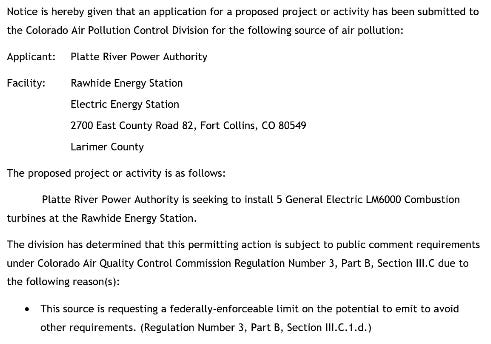
Under the Clean Air Act, a permitting authority may only rely on emissions limits, operational restrictions, or reductions if they are legally enforceable as a practical matter. That phrase carries specific meaning. To be creditable for purposes of determining whether a project is “major” or “minor,” a limitation must be:
clearly defined,
binding on the source,
enforceable by regulators and the public, and
incorporated into the permit in a way that survives changes in operation, ownership, or intent.
Assumptions, expectations, modeling scenarios, and voluntary commitments do not meet this standard unless they are translated into enforceable permit conditions.
This principle is what separates planning from law.
Why federal enforceability matters at the applicability stage
The Clean Air Act’s applicability framework is intentionally conservative. Regulators are required to evaluate what a source is authorized to do, not what it expects or intends to do. This is why potential-to-emit—not projected or modeled emissions—governs major-source determinations unless enforceable limits reduce that potential.
The reason is straightforward: once a permit is issued, the operator is legally entitled to operate up to the limits of that permit. If emissions reductions are not enforceable, they cannot be relied upon to justify a streamlined permitting pathway. Otherwise, the permit would rest on a hope that the source behaves as modeled, rather than on a legal obligation that it must.
This is where the Rawhide permit falters repeatedly.
Contingent actions are not federally enforceable reductions
The enforceability problem arises with respect to Rawhide Unit 1’s proposed retirement. The permit treats the unit’s shutdown as a completed emissions decrease and uses it to offset increases from the new turbines.
But the retirement is not federally enforceable at the time of permitting.
The permit conditions retirement on the submission—and continued validity—of a cancellation request that the operator can withdraw. The structure explicitly allows for toggling between scenarios in which Unit 1 is retired and scenarios in which it continues to operate. That means the shutdown is contingent, reversible, and controlled by the source.
Under the Clean Air Act, such a reduction cannot be credited. To count for applicability purposes, a decrease must be permanent and enforceable—not dependent on a future administrative action that can be undone at the operator’s discretion.
Treating a revocable shutdown as a real emissions reduction is not just optimistic; it directly contradicts the enforceability requirements embedded in the Act and Colorado’s SIP.
Why this undermines the permit’s legal foundation
The failure of federal enforceability effectively means that the permit’s “minor” status rests on emissions reductions and limitations that do not legally exist. When federal enforceability is stripped away, what remains is the full authorized operation of multiple new combustion turbines—operation that exceeds major-source thresholds.
This is not a discretionary judgment call. It is the direct consequence of applying the Clean Air Act’s enforceability rules as written.
And it explains why the misclassification issue is not merely technical. By relying on assumptions, scenarios, and contingent actions that are not federally enforceable, the permit bypasses the Act’s gatekeeping function. It allows a project that should have triggered heightened preconstruction safeguards to proceed under a streamlined pathway that the law does not authorize.
In that context, the absence of a public hearing is not an isolated procedural choice. It is the downstream effect of an enforceability failure that permeates the permit from the start.
Geographical context that demands care, not shortcuts
Finally, Rawhide’s geographic context matters. The facility sits immediately upwind of the Denver Metro/North Front Range ozone nonattainment area. While nonattainment status does not alter major thresholds directly, it heightens the importance of accurate emissions accounting and defensible findings.
In sensitive airsheds, the Clean Air Act’s preventive structure matters most. Shortcuts that might be inconsequential elsewhere carry amplified risk.
The bottom line
Any one of these defects would be sufficient to invalidate the permit’s classification as “minor.” Together, they paint a consistent picture. In Draft Permit 24LR0705, emissions reductions are manufactured artificially through accounting techniques the law does not allow. Modeling assumptions are treated as enforceable limits when they are not. Emissions decreases are credited despite being contingent and revocable. And binding constraints that could have preserved minor status are simply absent.
This is not how the Clean Air Act’s gatekeeping function is supposed to work.
When a permit reaches a “minor” outcome only by relying on unlawful accounting, unenforceable assumptions, and non-creditable decreases, the result is not streamlined compliance—it is the erosion of the very safeguards Congress designed to apply before construction begins.
In that light, the unresolved question of a public hearing is not a procedural curiosity. It is the natural consequence of a classification decision that never should have closed the gate in the first place.
Section IV
What Was Actually Requested — and What Wasn’t
Before turning to how CDPHE/APCD responded to public engagement on the Rawhide permit, it is worth pausing to clarify a basic but often misunderstood point: what the public actually asked for—and what it did not.
The hearing requests submitted during the public comment period were not attempts to halt PRPA’s project by procedural ambush. They were not demands that regulators adopt a particular energy policy, nor efforts to relitigate broader debates about coal, gas, or climate strategy through the permitting process. They did not ask the Air Quality Control Commission to overrule staff findings sight unseen or to substitute political judgment for technical expertise.
What was requested was far narrower, and far more ordinary.
During the comment period for Construction Permit 24LR0705, members of the public submitted written comments identifying threshold legal and technical issues concerning Clean Air Act applicability. Those comments included questions about whether the permit had been correctly classified as “minor,” and whether the preliminary analysis supporting that classification was sufficient. In parallel, a public hearing was requested so those threshold issues could be examined in an open forum before construction authorization was finalized.
That is a conventional request within a regulatory system built on preconstruction review.
A public hearing, in this context, is not a referendum on the project itself. It is a procedural mechanism designed to surface disputed assumptions, clarify the basis for key determinations, and ensure that oversight bodies are aware when the application of governing law is contested. It does not compel a particular outcome; it creates a forum for examination.
In the Rawhide case, the hearing request was rooted in the recognition that the “major vs. minor” classification is a gatekeeping decision under the Clean Air Act. If that classification is wrong, the downstream process is wrong with it. A hearing would have allowed that question to be addressed directly, before the consequences of misclassification became irreversible.
This is where timing matters.
The Clean Air Act draws a sharp distinction between preconstruction and post-construction review for a reason. Preconstruction review determines whether heightened safeguards apply before a project is built. Operating permits, by contrast, assume that construction has already been lawfully authorized. They focus on ongoing compliance, not on whether the facility should have been subject to major source review at the outset.
When CDPHE/APCD suggested that concerns could be raised later, during the operating permit process, it effectively proposed shifting a preconstruction question into a post-construction forum. That shift is not neutral. It changes the scope of review and forecloses remedies that are only available before construction begins.
The hearing request was an effort to avoid that procedural displacement. It sought clarity at the moment when clarity still mattered.
Equally important is what the request did not seek. It did not ask for an evidentiary trial, cross-examination of witnesses, or months of delay. It did not demand that regulators abandon their technical judgment. It did not ask the Air Quality Control Commission to decide the merits of the project. It asked only for an opportunity to address whether the Clean Air Act’s applicability thresholds had been correctly applied, and whether the permit had been placed on the proper regulatory track.
That distinction matters because it goes to the legitimacy of the process itself.
Regulatory systems derive public trust not from always reaching popular outcomes, but from demonstrating that decisions are made transparently, lawfully, and with due consideration of contested issues. A clear grant or denial of a hearing request—accompanied by an explanation grounded in the governing framework—serves that purpose. Ambiguity does not.
In the Rawhide permitting process, the absence of a clear determination has left public participants in an unusual position. Hearing requests were submitted. Concerns were raised about Clean Air Act applicability. The agency has indicated that it is continuing to review comments and aims to complete its work in the coming months. Yet it has not squarely addressed whether the disputed classification issues affect hearing eligibility, nor has it clearly stated whether the hearing requests were granted or denied.
That procedural uncertainty is not simply frustrating; it is consequential. Without clarity, participants cannot know whether their concerns have been considered and rejected, or whether they have simply been sidelined by an assumption embedded in the permitting path itself.
This is why the distinction between “what was requested” and “what was not” deserves emphasis. The public did not ask for extraordinary intervention. It asked for confirmation that the Clean Air Act’s gatekeeping function was being applied correctly, and for a forum to address that question if it was not.
Whether that request should ultimately be granted or denied is a matter for regulators to decide. But declining to engage the question—by treating the classification as settled without addressing the substance of the dispute—undermines the very process the Act is designed to protect.
The next step, then, is to look closely at how CDPHE/APCD responded to these requests, what its communications emphasized, and what they left unresolved. That response sheds light not only on the fate of a single hearing request, but on how the Clean Air Act’s preconstruction safeguards are being interpreted—and potentially narrowed—in practice.
Section V
The Agency Response — What Was Said, and What Wasn’t
When CDPHE/APCD responded to public inquiries about the Rawhide permit and the availability of a hearing, it did so in measured, professional language. The responses were polite, process-oriented, and largely consistent across communications. At first glance, they appeared to offer a straightforward explanation of how Colorado’s air permitting system works.
But a closer reading reveals something more subtle: the agency answered a different question than the one that had been asked.
In its communications, CDPHE/APCD emphasized several points. It explained that the Rawhide permit is a construction permit, issued to determine whether proposed equipment will comply with federal and state air quality standards before construction begins. It noted that under current regulations, only certain permits are eligible for a Commission hearing—specifically initial or renewal Title V permits, significant Title V modifications, and permits subject to Major Prevention of Significant Deterioration or Nonattainment New Source Review. Construction permits, the agency stated, do not themselves provide a mechanism for a public hearing.
The agency also pointed out that hearing requests may be submitted and considered later, during the operating permit process, which focuses on ensuring long-term compliance once a facility is operating. Finally, it indicated that public comments were still under review and that the Division aimed to complete its responses in the coming months.
Taken at face value, none of this is incorrect as a general description of the permitting framework. The problem lies not in what was said, but in what those statements quietly assume.
The response treats the Rawhide permit’s classification as settled. Hearing eligibility is discussed as a function of permit type—construction versus operating—without addressing the threshold question raised in the comments and hearing requests: whether the permit was correctly classified as “minor” in the first place. That classification is precisely what determines whether Major PSD review applies, and therefore whether a hearing is available at the preconstruction stage.
In other words, the agency’s explanation presumes the answer to the very question the public was asking.
Nowhere in the response does CDPHE/APCD state whether it evaluated the applicability arguments raised in the comments in connection with hearing eligibility. There is no indication that the agency examined whether the project might qualify as a major modification, or whether disputed emissions accounting and enforceability issues affected the procedural track. The response does not acknowledge that the “major vs. minor” determination itself was contested, nor does it explain how that contest was resolved.
Equally important, the communications do not clearly state whether the hearing requests were formally granted or denied. Instead of a determination, the public received a description of process categories and future opportunities. That distinction matters. A denial—accompanied by an explanation grounded in the governing framework—would at least clarify that the agency had considered and rejected the request. A generic response, by contrast, leaves open whether discretion was exercised at all.
The suggestion that concerns can be raised later, during the operating permit process, further underscores this gap. As discussed earlier, operating permits do not revisit preconstruction applicability. They assume that construction has already been lawfully authorized and focus on ensuring compliance with existing limits. Deferring a threshold classification dispute to that stage does not preserve the same protections; it displaces them.
That displacement is not a neutral administrative choice. It effectively removes Air Quality Control Commission-level visibility from a decision that the Clean Air Act intends to be resolved before construction begins. By the time an operating permit is issued, the opportunity to apply major source safeguards has passed.
The distinction between denial and non-response is not merely academic. In administrative law, clarity matters because it defines the record. A clear determination—whether affirmative or negative—allows participants to understand the basis for the decision and, if necessary, seek review. Ambiguity does neither. It leaves participants uncertain whether their arguments were considered, and it obscures the point at which the agency concluded that heightened safeguards were not required.
The practical effect of CDPHE/APCD’s response is that the permit review proceeds on the assumption that minor classification is correct, without a transparent explanation of how that conclusion was reached in light of the objections raised. Public participants are left without a clear answer as to whether their request for a hearing was denied on the merits, declined as categorically unavailable, or simply set aside pending completion of the agency’s internal review.
This matters because the Clean Air Act’s preconstruction safeguards depend on more than technical modeling; they depend on process clarity. When classification is assumed rather than examined, the gatekeeping function of the law weakens. Decisions that should trigger heightened scrutiny instead move forward under streamlined procedures, not because the law compels that result, but because the question was never squarely addressed.
In that light, the agency’s response is less a resolution than a deferral—one that leaves the core issue intact. If the permit is properly classified as minor, the absence of a hearing may be justified. But if that classification is wrong, then the procedural path taken has already foreclosed safeguards the Clean Air Act was designed to guarantee.
The remaining question, then, is not simply whether CDPHE/APCD followed its usual process. It is whether that process, as applied here, allowed a contested classification decision to quietly determine the outcome without the transparency and scrutiny the law requires.
Section VI
Why “You Can Raise It Later” Doesn’t Work Under the Clean Air Act
At first glance, the suggestion that concerns can be addressed later—during the operating permit process—sounds reasonable. Regulatory systems often work in stages. Agencies review projects incrementally. Operating permits do involve public notice and comment. From a distance, deferral can look like patience rather than dismissal.
But under the Clean Air Act, timing is not a matter of convenience. It is a core feature of the law’s design.
The Act deliberately places its strongest safeguards at the preconstruction stage, precisely because that is when meaningful choices are still available. Before a facility is built, regulators can determine whether heightened review applies, require enforceable limits, and ensure that emissions increases are justified under the governing standards. Once construction is authorized, those questions are no longer open in the same way.
This is why applicability determinations—such as whether a project qualifies as “major” or “minor”—are threshold decisions. They decide which regulatory track applies before the project moves forward. They are not advisory judgments that can be revisited at any time. They determine, at the outset, whether the law’s preventive framework is engaged.
Operating permits serve a different function. They are designed to consolidate applicable requirements and ensure ongoing compliance once a facility is already operating. They do not reopen preconstruction determinations. They do not ask whether a project should have been subject to major source review. They assume that the facility was lawfully authorized under the correct permitting pathway.
This distinction matters because it exposes a fundamental mismatch in the idea of deferral. When a disputed classification question is pushed to the operating permit stage, it is not preserved—it is effectively decided. By the time an operating permit is issued, the opportunity to apply preconstruction safeguards has passed.
In practical terms, deferral collapses the Clean Air Act’s gatekeeping function. A decision that should be resolved before construction becomes an implicit assumption embedded in the project’s foundation. Commission-level visibility is reduced. The administrative record narrows. The law’s preventive structure gives way to a compliance framework that was never meant to answer threshold questions.
Public hearings are part of this structure for a reason. They are not intended as spectacles or veto points. They are forums for surfacing unresolved assumptions, testing enforceability, and ensuring that contested interpretations of governing law are addressed transparently before irreversible steps are taken. When a hearing is deferred along with the issue that would justify it, the function it serves disappears.
Deferral also creates an asymmetry that is easy to overlook. Agencies and applicants lose little when a classification question is postponed. Permit review proceeds. Construction authority is granted. Timelines are maintained. The costs of uncertainty are minimal.
The public, by contrast, bears the full consequence. Once construction begins, leverage is gone. Even if concerns resurface later, the remedies available are narrower, the standards different, and the practical stakes higher. What might have been a correctable classification error becomes a legacy condition embedded in an operating facility.
This asymmetry is not accidental; it is precisely what the Clean Air Act was designed to avoid. The law recognizes that front-loading scrutiny is essential because downstream corrections are rarely equivalent substitutes. That is why it insists on resolving applicability before construction, not after.
The implications extend beyond a single permit. If deferral becomes an acceptable response whenever classification is disputed, the distinction between “major” and “minor” loses its force. Minor status becomes self-confirming: once assumed, it justifies streamlined process, which in turn prevents the scrutiny that might have challenged the assumption in the first place.
That is not a failure of intent; it is a failure of structure. And it is one the Clean Air Act was expressly written to prevent.
Seen in this light, the unresolved status of the Rawhide hearing request is not a procedural footnote. It reflects a deeper question about whether preconstruction safeguards are being treated as mandatory gatekeepers or as optional steps that can be postponed until they no longer matter.
If threshold applicability questions can always be raised “later,” then the moment when the Clean Air Act’s strongest protections are supposed to apply quietly slips out of reach. And when that happens, the law’s preventive promise—its insistence on getting the call right before construction begins—becomes increasingly difficult to fulfill.
Section VII
Why This Matters Beyond Rawhide
It would be a mistake to view the Rawhide permitting dispute as an isolated controversy tied to a single project or a single agency decision. What makes this case significant is not who is involved, but what it reveals about how Clean Air Act safeguards function—or fail to function—when classification decisions are disputed.
Rawhide serves as a case study. It shows how much hinges on a threshold determination that is often treated as technical and routine, but which in practice shapes the entire regulatory pathway that follows. When a project is classified as “minor,” it moves forward under streamlined review. When it is classified as “major,” a different set of questions must be answered, and a different level of transparency applies. That fork in the road is not merely procedural; it determines how seriously the law’s preventive intent is taken.
Classification decisions are powerful precisely because they operate quietly. They are made early, often embedded in technical analyses, and rarely revisited once assumed. Yet they determine the scope of emissions analysis, the enforceability of limits, the visibility of decisions, and the availability of public forums. In this sense, “major vs. minor” is not a label—it is the fulcrum on which Clean Air Act protections turn.
The risk exposed by the Rawhide process is not only that agencies may act in bad faith, but that institutional pressures can gradually reshape how safeguards are applied. Permitting agencies face real demands: large workloads, statutory timelines, evolving policy expectations, and increasing project complexity. Streamlined pathways exist for good reasons. But when efficiency becomes the default response to contested classification questions, the balance the Clean Air Act struck begins to shift.
Over time, that shift can normalize shortcuts. Accounting assumptions harden into precedent. Modeling expectations substitute for enforceable limits. Deferral becomes routine. What begins as case-specific discretion quietly becomes institutional habit. And habits, once established, are difficult to unwind.
This matters not only for environmental outcomes, but for public trust. Regulatory systems depend on meaningful participation to maintain legitimacy. When members of the public engage in good faith—submitting comments, raising threshold questions, requesting hearings—and are met with ambiguity rather than clarity, confidence in the process erodes. Future participation declines. Skepticism grows. Decisions that may be technically defensible nonetheless feel opaque and preordained.
The consequences are uneven enforcement and diminished predictability. Regulated entities benefit from clarity about which rules apply and why. Communities benefit from knowing when heightened safeguards will be triggered. Agencies benefit from a clear record that demonstrates consistent application of governing law. When classification disputes are resolved implicitly rather than explicitly, none of those interests are well served.
Perhaps most importantly, early correction protects everyone involved. Identifying and resolving misclassification before construction begins avoids downstream conflict, litigation risk, and remedial complexity. It preserves agency credibility, reduces uncertainty for applicants, and ensures that projects move forward on a legally sound foundation. Far from being obstructionist, early scrutiny is a form of institutional risk management.
The Clean Air Act was designed with this logic in mind. Its preventive structure reflects an understanding that environmental harm, once embedded in physical infrastructure, is far harder to address. That is why the law insists on getting the call right at the front end, when decisions are still reversible and safeguards still meaningful.
If classification disputes can routinely be deferred, however, that preventive structure weakens. Minor status becomes self-reinforcing. Hearings become theoretical. And the distinction between major and minor—meant to function as a gatekeeper—loses its practical force.
The lesson of Rawhide, then, is not about one permit. It is about whether the systems designed to protect air quality and public participation remain robust when they are tested. When classification decisions quietly decide outcomes, the law’s strongest protections risk becoming conditional rather than mandatory.
That raises a simple but far-reaching question: when the Clean Air Act makes classification the gatekeeper, what happens when the gate is assumed open rather than deliberately examined?
Conclusion
Why Getting the “Major vs. Minor” Call Right Still Matters
The Clean Air Act is often described in terms of long-term goals—cleaner air, healthier communities, and a more sustainable energy system. But its effectiveness depends on something far more immediate: whether its safeguards are applied at the moment they are meant to operate. The law’s strongest protections are front-loaded by design, triggered before construction begins, when decisions are still reversible and scrutiny can still shape outcomes.
The Rawhide permitting process brings that design into focus. At its center is a threshold determination—whether the proposed changes should be treated as a “major” or “minor” modification—that quietly dictates everything that follows. That classification determines the depth of review, the enforceability of limits, the visibility of decisions, and whether the public has access to a meaningful forum before construction is authorized.
As this article has shown, the minor classification applied to Construction Permit 24LR0705 rests on a series of assumptions that do not align with how the Clean Air Act is meant to function. Emissions reductions are credited where the law requires permanence and enforceability. Modeling expectations are treated as if they were binding limits. Preconstruction questions are deferred to post-construction processes that cannot meaningfully address them. The result is not merely a disagreement over analysis, but a narrowing of the very safeguards the law was designed to ensure.
This is not a dispute about outcomes. It is a dispute about process integrity. The public did not ask regulators to decide against the project; it asked that the correct legal pathway be applied, and that contested threshold questions be examined openly before irreversible steps were taken. That request remains unresolved.
Clarity still matters now. The permit review is ongoing, and the classification question has not been transparently addressed. Whether a hearing ultimately occurs is less important than whether the basis for granting or denying one is clearly articulated and grounded in the governing framework. A clear determination—supported by explanation—strengthens the administrative record and reinforces confidence in the process, regardless of the outcome.
When threshold applicability questions remain contested at the staff level, the Clean Air Act anticipates a broader forum for consideration. In Colorado, that role belongs to the Air Quality Control Commission. Commission awareness of disputed interpretations is not an escalation in the adversarial sense; it is a structural feature of the system, designed to ensure consistency, transparency, and accountability when classification decisions shape consequential outcomes.
Early resolution of such questions serves everyone’s interests. Agencies benefit from a defensible record and reduced downstream risk. Applicants gain certainty that their projects rest on a solid legal foundation. Communities retain confidence that participation is meaningful rather than procedural. And the Clean Air Act’s preventive structure—the insistence on getting the call right before construction begins—remains intact.
Ultimately, the distinction between “major” and “minor” is not a technical footnote. It is the hinge on which public oversight and environmental safeguards turn. Treating that decision as assumed rather than examined weakens the law quietly, without a single overt violation. Treating it with the care the statute demands strengthens governance, even when conclusions are contested.
Getting the “major vs. minor” call right is the difference between a process that protects the public before construction—and one that asks the public to accept the outcome after it’s too late to matter.